Exploring Common Chord Progressions
Explore common chord progressions, what makes them so powerful, and how they’re used in popular music to make a song stick.


Chord progressions – the movement from one chord to another – is the harmonic bedrock of music.
Certain sequences of chords are used more often than others, which is part of what we take for granted as music sounding “normal”. Ear training can help you to recognise chord changes and common chord progressions by ear so that you can write them down, play them on your instrument, or solo over the top of them.
Particular chord changes tend to have characteristic uses, and learning their sounds is very empowering as a musician. For example, a chord change such as the “perfect cadence” can create a strong sense of resolution, or in the hands of Richard Wagner can take the listener in unsettling new directions.
Some genres such as the blues are even defined by their characteristic progressions, while hip-hop, and drum’n’bass are notable for their lack of harmonic movement.
Though a musician is free to string together any chords to create their own chord progressions, Western music typically follows particular rules and traditions of harmony that result in the familiar musical sounds we all know instinctively just through regularly listening to music. This means there are some particularly effective ways to organise chords, and a number of classic chord sequences such as the “three chord trick“, the “circle of fifths” and the “doo wop progression”.
This allows you to:

For details on how to plan your ear training to recognise chord progressions, read the full article “Chord Ear Training How-To: Chord Progressions” which explains the step-by-step process to develop your ear to recognise the most commonly-used chord progressions in music.
Did you know that an astonishing number of songs use just three chords? And in fact, it’s the same three chords? The classic I-IV-V chord progression is everywhere in rock and pop music – and even in classical! Discover the 3 chords every musician should know and why you should learn the I-IV-V chord progression.
When you’re ready to go beyond three chords, introduce the “minor 6” and you have the 4 most common chords in music. There’s one particular 4-chord progression that you. Discover the most important four-chord progression and why you need just Four Chords and the Truth to write a hit song.
 Inside Musical U you’ll find a set of ear training modules for learning to recognise chord progressions by ear, along with a detailed roadmap to guide you and a large number of exercises and interactive quizzes to help develop your skills.
→ Learn more about Musical U membership
Here are some listening exercises (MP3 training tracks) and an interactive quiz to help you practice recognising the chords in common chord progressions.
You can listen to the tracks or download them to practice with on your computer or mobile device. The exercises come with three difficulty levels: The “easy” exercise uses just root-position triad chords, making it easy to hear the movement of the root up to the fourth, fifth, and sixth degrees of the scale. The “medium” exercise introduces different inversions of the chords, which means the notes can change without it actually changing chord in the progression. The “hard” exercise doesn’t play a scale before the progression so you have an extra challenge! We recommend practising with each difficulty level in order for the exercises, building up a robust ability to recognise those progressions in varied musical use.
→ Chord Ear Training Exercises
 Learning to easily identify the chords to a song just by listening to it is an important skill for any musician. If you play chords on your instrument, it frees you from sheet music or looking up the chord chart to play a new song. If you improvise it tells you clearly which notes will sound good and fit well. And even if you do neither of those things, having a keen understanding of the harmony in music is vital for good musicianship and confidence in music.
This roadmap covers an approach which will allow you to quickly play the chords to a large number of songs by ear.
There are many types of chord and the possibilities for chords in a song are practically endless so it is easy to get overwhelmed and make slow progress trying to play chords by ear.
Fortunately we can take advantage of musical conventions to focus on the most commonly-used chords and progressions. This will let you learn to play chords by ear much more efficiently than traditional approaches.

Learn all about what chord progressions are and why they’re important in music.
After completing this module: you will understand what chord progressions are and how learning to recognise the most common ones will help you to be more musical.

Learn how the same 3- and 4-chord progressions power thousands of hit songs and how you can play them by ear with the 3-Chord Songs and the 4-Chord Trick eBook.
After completing this module: you will understand what the I, IV, V and vi chords are, and why their progressions are so important.

Practice recognising the most common chord progressions by ear.
After completing this module: you will be able to reliably recognise the I, IV, V and vi chords in progressions.

Start to practice your I, IV, V chord recognition skills with realistic music tracks in a variety of styles: Pop, Rock, Dance, Solo Piano and Solo Guitar.
After completing this module: you will be able to recognise 3-chord (I-IV-V) progressions in a variety of musical styles.

Practice your I, IV, V, vi chord recognition skills with realistic music tracks in a variety of styles: Pop, Rock, Dance, Solo Piano and Solo Guitar.
After completing this module: you will be able to recognise 4-chord (I-IV-V-vi) progressions in a variety of musical styles.
Practice using the bassline of I, IV, V, vi chord progressions to recognise the chords with realistic music tracks in a variety of styles: Pop, Rock, Dance and Solo Guitar.
After completing this module: you will be able to recognise 4-chord (I-IV-V-vi) progressions in a variety of musical styles by listening to the bassline.
Apply your chord recognition skills to real music, recognising the I-IV-V chords and playing 3-chord songs by ear with the Popular Progressions training album.
After completing this module: you will be able to recognise 3-chord (I-IV-V) progressions in real music.
Apply your chord recognition skills to real music, recognising the I, IV, V and vi (six minor) chord and learn to play four-chord songs by ear with the Classic Chords training album.
After completing this module: you will be able to recognise 4-chord (I-IV-V-vi) progressions in real music.
Explore common chord progressions, what makes them so powerful, and how they’re used in popular music to make a song stick.
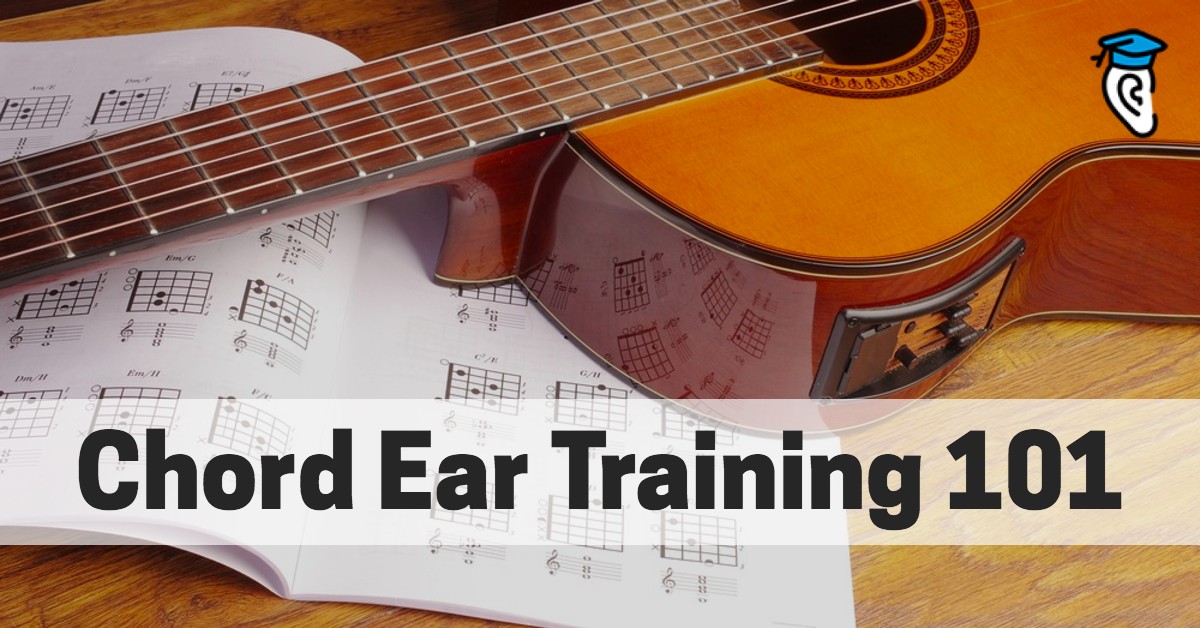
Learn to play the most common chords and chord progressions by ear and find out how they are used in a variety of genres – rock, jazz, and classical.

If you write songs, you’ve probably been faced with the troubling ‘blank page’ syndrome when choosing chords. Learn how to get unstuck and write better songs.

What if learning music theory was a mind-blowing and immediately-useful experience? Shelle Soelberg from Let’s Play Music reveals the key.
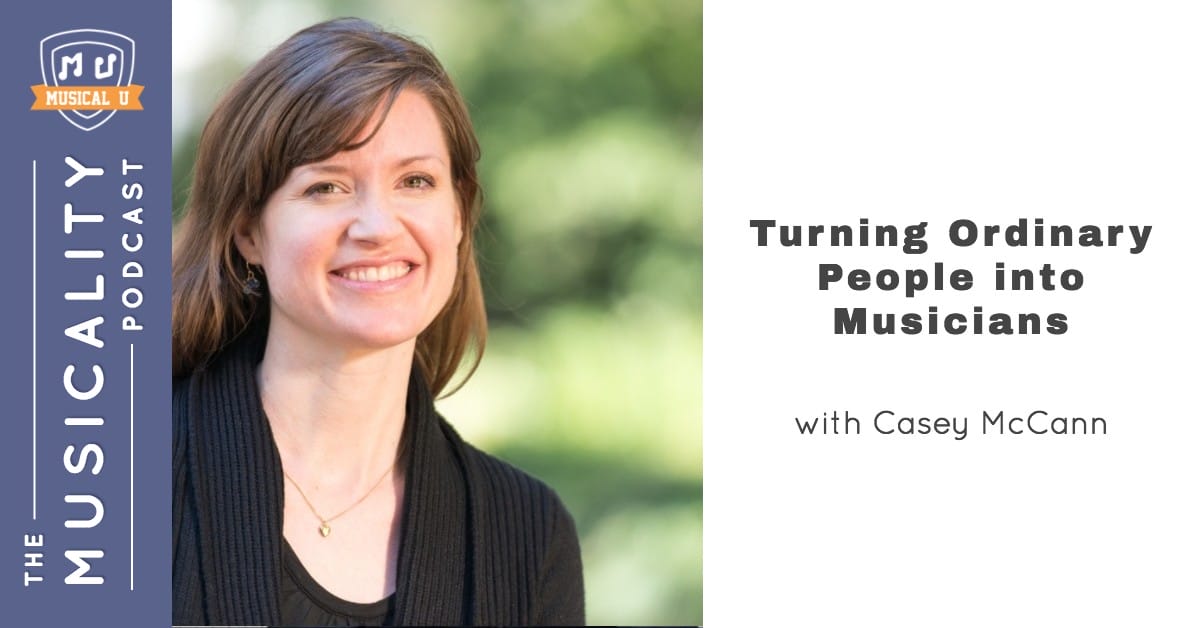
The Musicality Podcast interviews music educator extraordinaire Casey McCann about how she developed musicality, and how she passes it on to her students.
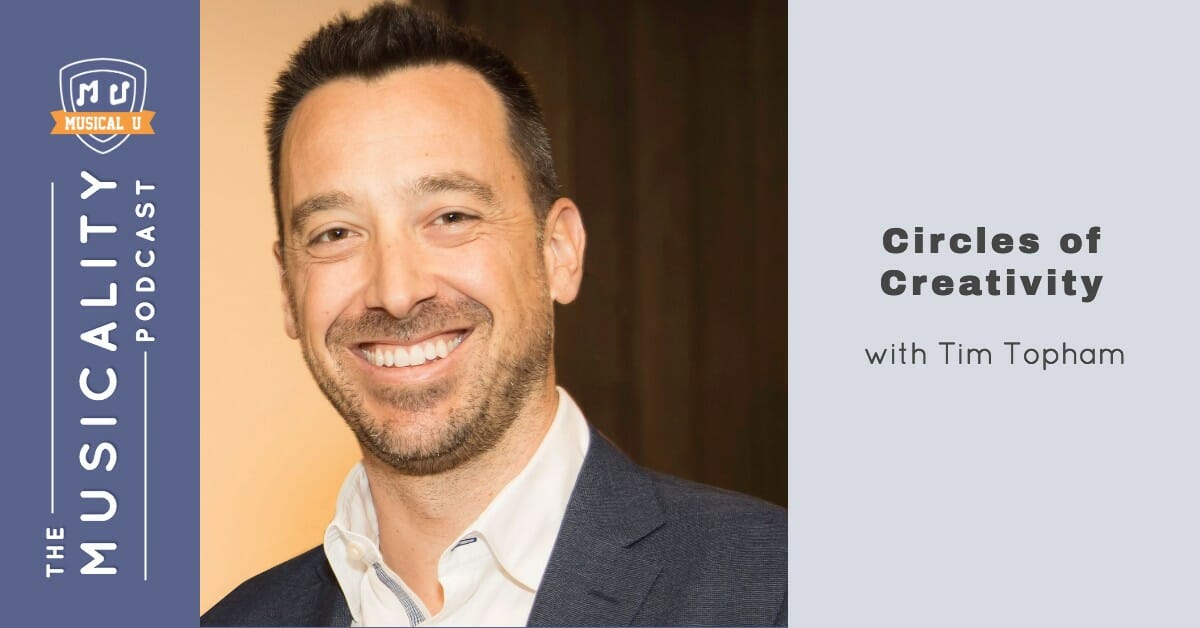
Tim Topham discusses how to bring music to life through creative music teaching, and how to marry this approach with traditional drill-based ear training.
Learn how to build minor chords and combine them into unforgettable progressions! Our exercises will get you playing through famous progressions in no time.
Did you know: a huge number of popular songs use just four chords. Find out which four and why in this article, and learn how to write your own 4-chord songs.
What better time than Halloween to explore music’s darker side? Dive into the world of minor and learn how to create your own creepy tune.
Open your ears to the versatile ii-V-I chord progression, learn its inner mechanics, and find out how you can use it in your own songwriting.

What are secondary dominants and what do they contribute to chord progressions? Learn how to hear them in a progression and how to use them in songwriting!


Musical U membership provides you with dozens of training modules, tools for goal-setting and planning, and a friendly, supportive community who will help you succeed.
Start reaching your true musical potential:

Download free ear training apps to help you improve your ear for music: